
CIVICSNZ
Political agreements
In 1996, New Zealand held its first mixed-member proportional (MMP) election.
When there is uncertainty over who has ‘confidence in the House’, the MMP process requires the Governor-General to draw on political statements, verbal or written, in order to form a view as to whether confidence in the House is attained and the tests of quantity and clarity have been achieved. As part of this process, the Governor-General is able to rely on verbal public assurances, although signed written documents are preferred. Although there is no requirement on a political party to make a signed agreement public, there is a political and ethical obligation to do so.
There are a number of ways a change of government can come about. See our diagram ‘How a change in government eventuates’ for a breakdown of the process by phases; depending on the circumstances some of these phases can take place over different time periods. Political agreements (verbal and/or written) can play a role in phase 2, the formation of government. The process is set out in the 2017 Cabinet Manual.
Importantly, agreements mentioned in the ‘speech from the throne’ do not necessarily form part of the appointment of government (by then the appointment process has been completed). Instead they are owned by the political parties concerned and are therefore not parliamentary papers or government agency records, which means there is no official record kept.
Under MMP, four types of government are likely to eventuate (although other permutations involving confidence and supply and/or co-operation agreements are possible):
- Majority single-party (single party with over 50% or more of the seats in the House held by one political party)
- Minority single-party (single party with 50% or less of the seats in the House held by one political party)
- Majority coalition (multiple parties with over 50% or more of the seats in the House govern together)
- Minority coalition (multiple parties with 50% or less of the seats in the House govern together)
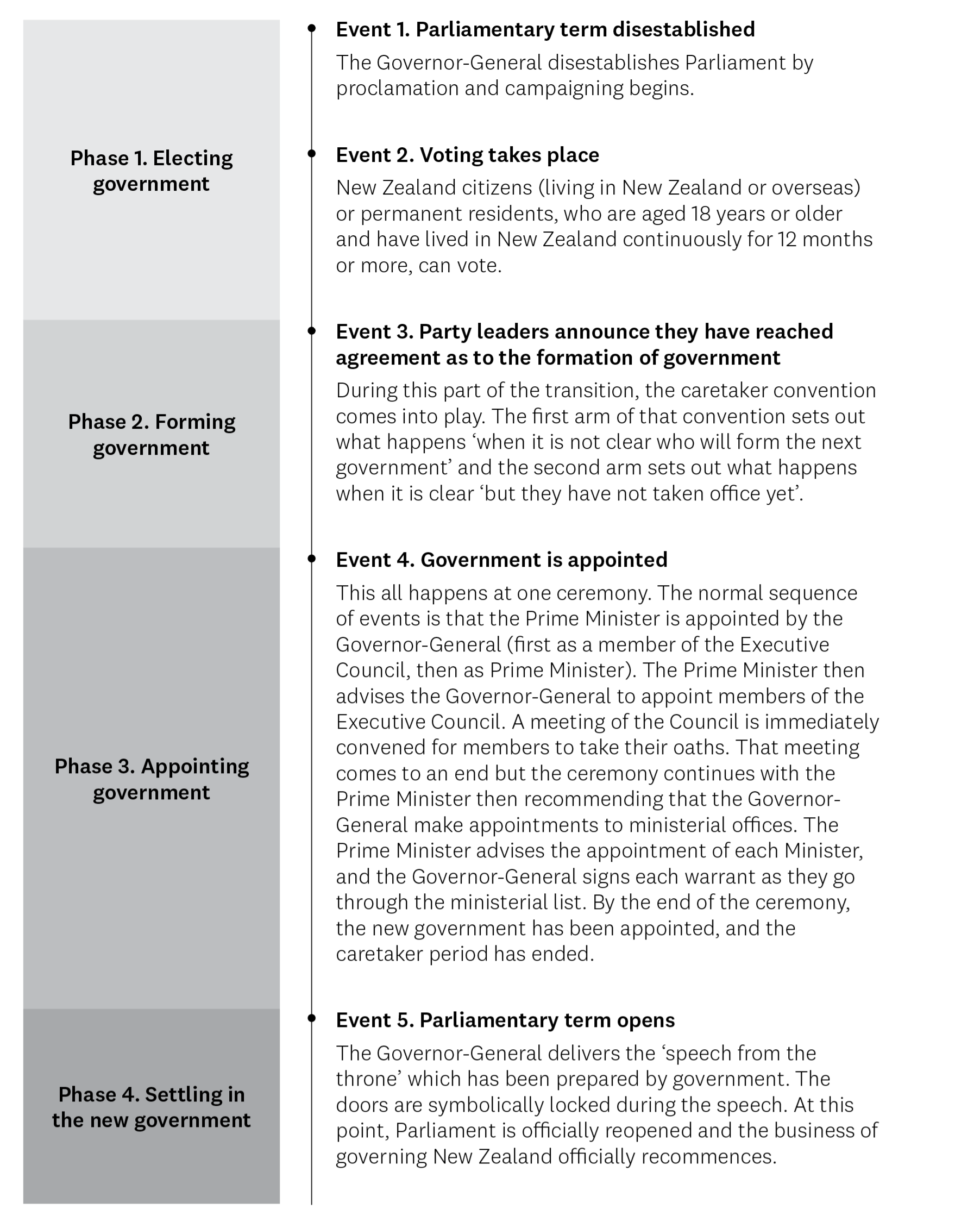
How a change in government eventuates

Significant political agreements since 1996 to 2020
Resources
Table 1: Coalition Agreements forming Government [5]
| Date | Major Political Party | Minor Political Party | Title of Agreement |
|---|---|---|---|
| 10 December 1996 | National | New Zealand First | The 1996 coalition agreement between National and New Zealand First |
| 6 December 1999 | Labour | Alliance | The coalition agreement [?] |
| 8 August 2002 | Labour | Progressive | Coalition Agreement between the Labour and Progressive Coalition Parties in Parliament |
| 17 October 2005 | Labour | Progressive | Coalition Agreement: Labour and Progressive Parties in Parliament |
| 24 October 2017 | Labour | New Zealand First | Coalition Agreement: New Zealand Labour Party & New Zealand First |
Table 2: Confidence and Supply Agreements forming Government [13]
# The Green Party supported the Coalition Government on confidence and supply issues but no written agreement was prepared. It is therefore included in the list below but not on the graph above. (Source: Parliamentary Library, Personal Communication).
Table 3: Agreements inside formation/inside Government [3]
| Date | Major Political Party | Minor Political Party | Title of Agreement |
|---|---|---|---|
| 26 August 2002 | Labour/Progressive | Green | Co-operation between the Labour/Progressive Government and the Green Parliamentary Caucus |
| 17 October 2005 | Labour | Green | Labour led Government Co-operation Agreement with the Green Party |
| November 2020 | Labour | Green | New Zealand Labour Party & Green Party of Aotearoa New Zealand: Cooperation Agreement |
Table 4: Agreements outside formation/inside Government [1]
| Date | Major Political Party | Minor Political Party | Title of Agreement |
|---|---|---|---|
| 8 April 2009 | National | Green | Memorandum of Understanding Between The New Zealand National Party and The Green Party of Aotearoa New Zealand |
Table 5: Agreements outside formation/outside Government [2]
| Date | Major Political Party | Minor Political Party | Title of Agreement |
|---|---|---|---|
| 25 May 2014 | MANA | Internet | Memorandum of Understanding Between the MANA Movement and the Internet Party |
| 2016 | Labour | Green | Memorandum of Understanding Between the New Zealand Labour Party and Green Party of Aotearoa New Zealand |